Blog | Tree Care
By the second week of September, drought stressed trees in Alexandria, VA start showing themselves in ways that are easy to miss if you don’t know what to look for. The shade trees here have been working for four solid months. A willow oak in a Del Ray back yard drops leaves that are still half green. The tulip poplar behind a Rosemont bungalow turns color weeks before anything else on the block. A homeowner looks up and wonders whether they are watching autumn arrive early, or a tree begin to fail.
Those two look nearly identical from the ground, and telling them apart is worth doing: one resolves on its own, the other compounds quietly for years.
A tree under water stress shuts down from the outside in, sacrificing what it can most afford to lose. That gives you a fairly reliable sequence of signals:
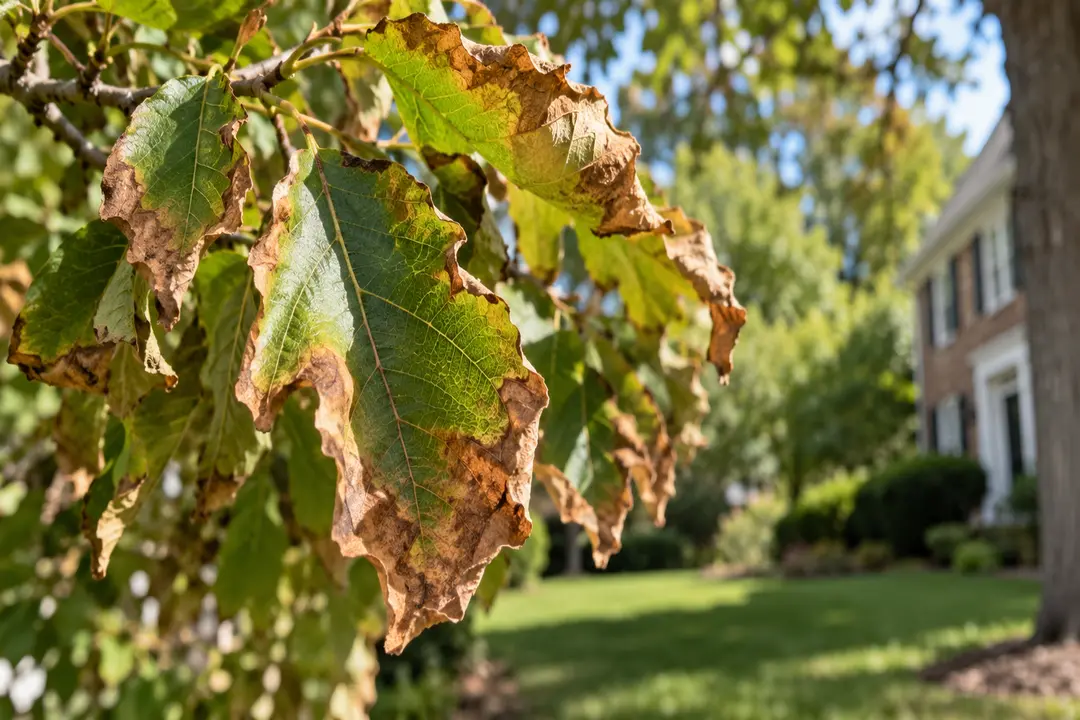
Where in the canopy it shows up matters. Virginia Cooperative Extension’s Tree Steward Manual notes that drought thinning starts in the top center of the crown, which is exactly the part of the tree a homeowner never looks at. By the time the problem is obvious at eye level, it has been underway a while.
One useful distinction: drought scorch tends to be even and to follow the leaf’s edges, while most foliar diseases produce spots, blotches, or damage in irregular patches. It is not foolproof, and the two often occur together, since a tree short on water is a tree with its defenses down.
Drought stressed trees are common in Alexandria, VA yards, and it isn’t just bad luck: the building stock here works against the canopy in a few specific ways.
Start underground. Much of this region sits on heavy Piedmont clay, which holds water well when moist and turns nearly impermeable when it is not. Run a hose hard on baked clay and much of it sheets toward the street instead of soaking in.
Then there is how little soil many of these trees actually have. In Old Town, mature trees live in narrow pits between brick sidewalk and curb, or in small walled gardens bounded by foundations on three sides. In the older bungalow neighborhoods, a large oak may stand over a modest lot that has since acquired a wider driveway, a patio, and a rear addition. That matters more than most people assume, because roots reach much farther than the branches do. Extension notes that trunk diameter predicts root spread better than canopy width, and a tree just six inches across at chest height can send roots out nearly twenty feet in every direction. Every square foot of that area under pavement collects nothing when it rains and yields nothing when it is dry.
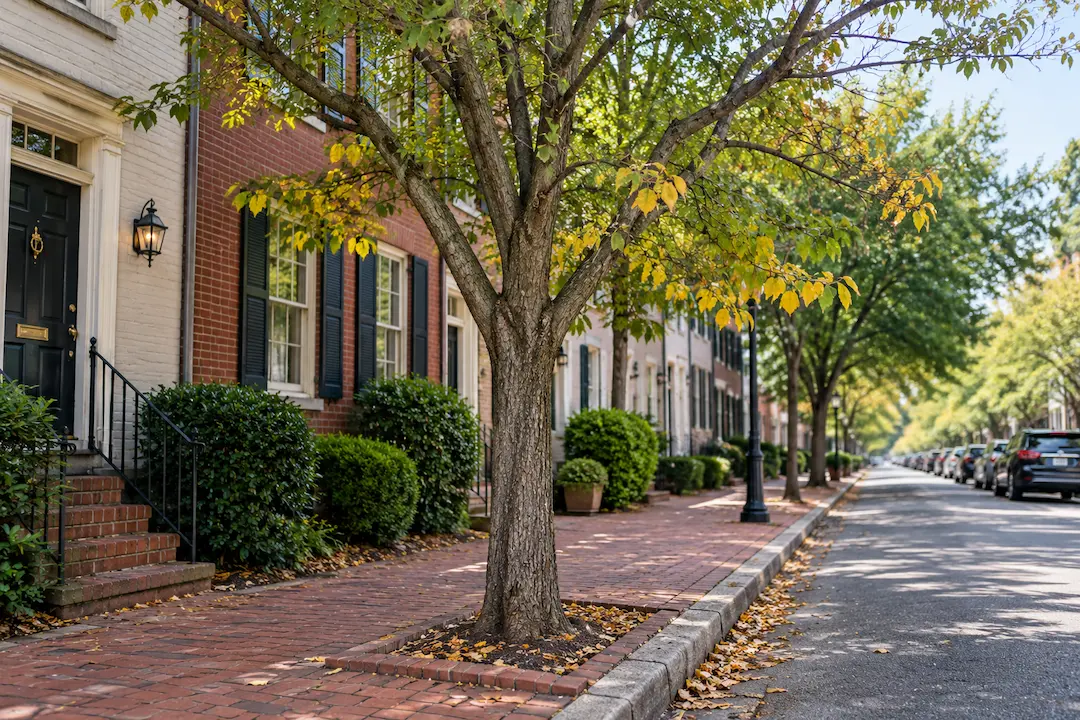
Masonry stores heat as well, pushing soil temperatures and evaporation up. And a great many Alexandria trees are watered by a lawn irrigation system, which is close to the worst arrangement for them: a light, frequent sprinkle that wets the top inch of soil, evaporates by mid-morning, and encourages shallow rooting. It keeps turf green and does almost nothing for a tree.
Drought stressed trees in Alexandria, VA don’t need a fixed daily amount so much as a consistent, deep soak. The figure you will find on most gardening sites is the Arbor Day Foundation’s rule of thumb for established trees: roughly ten gallons of water per inch of trunk diameter, measured at about knee height (Arbor Day Foundation guidance, reviewed 2026-09-10). It is a reasonable starting point, but published numbers vary, and no table can account for your particular species, soil, and root volume.
Virginia Cooperative Extension gives a method instead of a number, which is more useful. Dig a small hole six to nine inches deep and see whether the soil down there is moist or dry. If it is dry, water at least out to the dripline, long enough to deliver about an inch of water, then check that depth again; if it is still dry, repeat. Do that a few times across a season and you learn how many days your own yard takes to dry out, which is worth more than any published schedule.
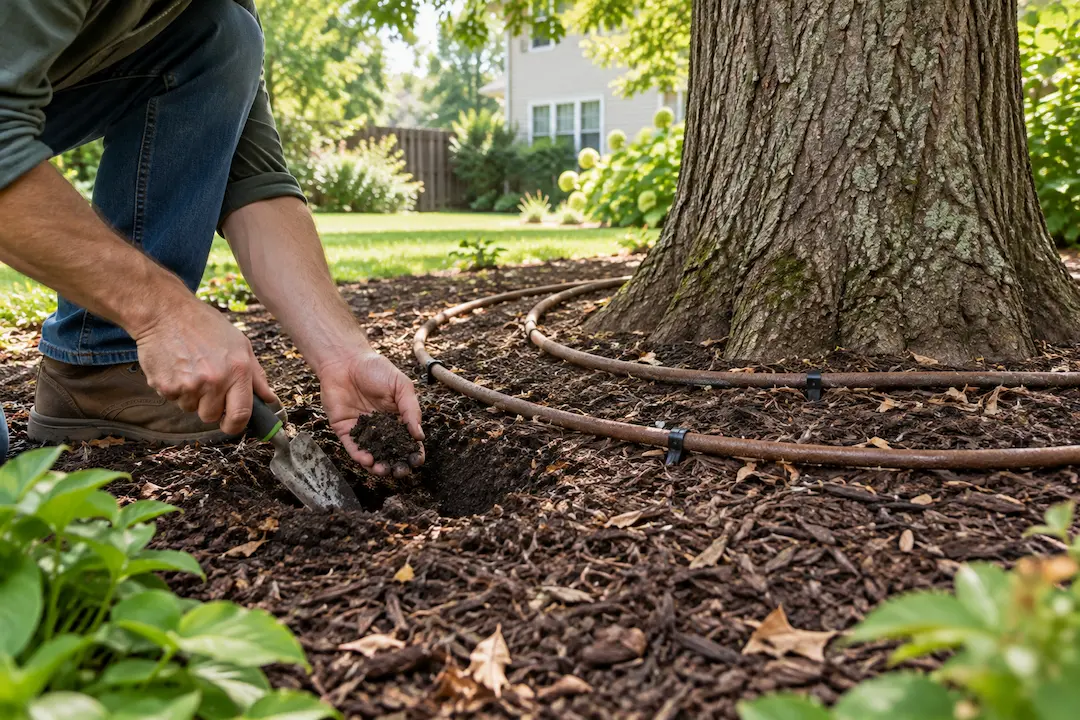
How you apply it matters as much as the total. Extension’s consumer horticulture specialist notes that the most common mistake in dry weather is watering too frequently and too lightly, and recommends watering early in the morning, aimed at the ground rather than the foliage, and skipping sprinklers. Studies cited there estimate that 20 to 30 percent of water applied by daytime sprinkler is lost to wind drift and evaporation before it reaches the roots. A soaker hose laid in a spiral out toward the canopy edge, or a hose at a slow trickle moved periodically, will do what a fast blast cannot.
Mulch matters here too. For established trees, Extension puts it at two to three inches deep, spread toward the dripline where practical and held six to twelve inches back from the trunk so the bark does not sit wet. Clearing turf from under the canopy helps as well, since grass competes directly with tree roots for water in the upper soil.
This surprises people who have just been told their tree is thirsty, but Extension puts it plainly: watering too much can be as dangerous as watering too little. Roots need oxygen as much as moisture. Saturated soil drives the air out of the pore spaces, roots suffocate, and the resulting conditions are exactly the ones root-rot pathogens favor.
The confounding part is that an overwatered tree looks much like an underwatered one: wilting, yellowing, thinning, so a homeowner who misreads the first symptoms can water a struggling tree into worse trouble. On slow-draining clay, that is an easy mistake. Check the soil before each watering rather than committing to a schedule.
There is no honest number here, and anyone offering one is guessing. A deeply rooted native oak on an open lot will coast through a dry spell that would kill a young ornamental in a sidewalk pit. Species, age, root volume, soil, and exposure move the answer by months.
More useful is understanding that the damage is cumulative and delayed. A tree that gets through a dry summer looking acceptable may have spent its reserves doing it, and the bill arrives later, as a weak spring flush, as dieback the following year, or as an opening for the boring insects and canker fungi that specialize in stressed trees. This is why decline so often seems to come out of nowhere: the cause was two seasons back. It is also why Extension advises watering preventively, before foliage stress shows.
Drought stressed trees in Alexandria often recover, but on the tree’s timescale, not yours. Recovery means rebuilding root mass and stored energy over multiple growing seasons, not one good soak in September. A few things help, and a few popular impulses hurt.
Some trees do not come back. When a substantial share of the crown has died back, when dieback advances year over year despite decent water, or when decay appears at the base, the conversation shifts from recovery to risk, and a declining tree over a house or a sidewalk becomes a question of when it comes down and on whose terms.
That call is hard to make from the ground, which is why a professional look at the tree’s structure and vigor is worth more in September than any watering chart. An arborist can separate drought scorch from a vascular disease, find decay you cannot see, and tell you whether the tree needs three seasons of patience or a plan.
My tree dropped a lot of leaves in August but looks fine otherwise. Should I worry?
Early leaf drop on its own is a coping mechanism, not a death sentence. Watch next spring instead: a full, normal leaf-out means it managed, while a late, sparse, or patchy flush means it is still in deficit.
Does my irrigation system already cover the trees?
Almost certainly not in any useful way. Lawn zones are designed for shallow-rooted turf and run briefly and often, which is the opposite of what a tree wants.
Is it too late in the season to start watering?
No. Root activity continues after leaf fall, and autumn watering during dry spells is useful going into winter. Keep checking the soil until the ground freezes.
How do I know whether we are actually in a dry period?
Rather than going by feel, the Virginia Department of Environmental Quality publishes current drought conditions by region. Check with your water provider as well, since local restrictions can apply in dry periods and may limit any extended watering.
G&V Tree Service sees drought stressed trees in Alexandria, VA yards every summer, and late summer is when the ambiguous cases surface, the tree that might be tired and might be declining. If something in your yard is browning early, thinning out, or dropping limbs, having it looked at now costs far less than dealing with it after it fails. We provide residential tree care throughout the area, including Alexandria and its surrounding neighborhoods.
G & V Tree Service Inc
6434 Brandon Ave Suite 204
Springfield, VA 22150
(703) 569-2570

Somewhere in a Kingstowne back yard there is an oak that forks...

The trees that come down in a Burke storm are rarely chosen...
We strive to keep up with and use modern tree care techniques. Our work is also conducted by tree specialists with decades of experience.
Contact Us